
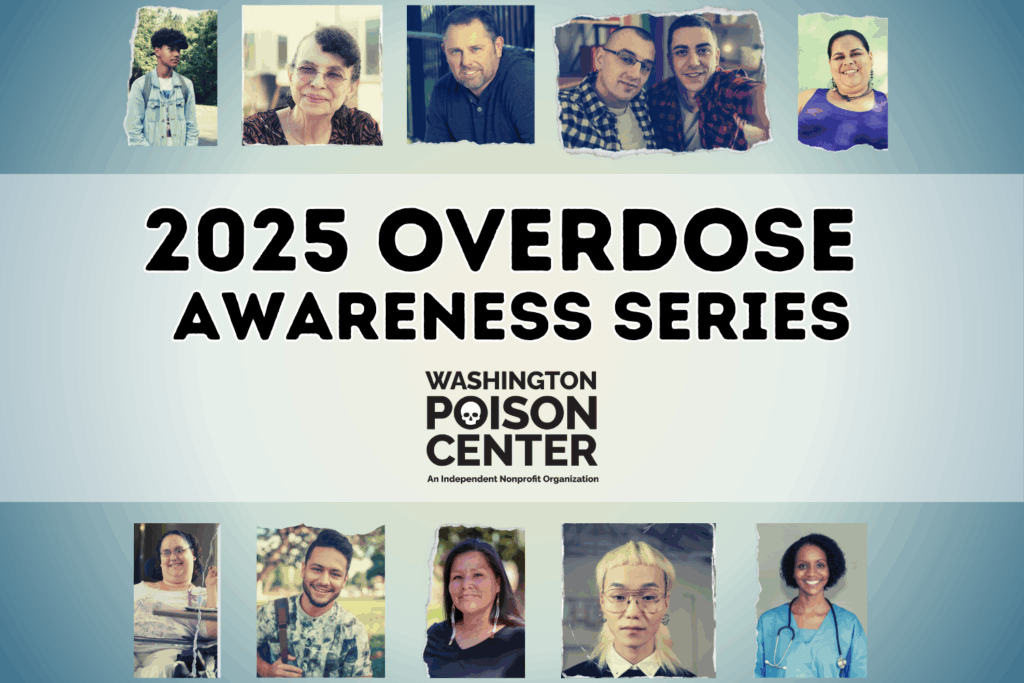
2025 Overdose Awareness Series
About the Series
Through presentations from Washington Poison Center staff and from external experts, this series explores unintentional and intentional factors that can lead to overdose, how to respond to different overdose situations, how to prevent and reduce harm from overdose, and how to access resources. Our goal is to open dialogue, de-stigmatize, and promote awareness of the help available in our communities.
The free virtual series took place the four Tuesdays in August 2025.
Mary Selecky Memorial Keynote
Join the Washington State Secretary of Health, Dennis Worsham, in a kick off session on the current challenges facing public health and hope moving forward.
This session is the inaugural Mary Selecky Memorial Keynote, which honors the remarkable legacy of Mary, a longtime public health leader, former Washington State Secretary of Health, and Washington Poison Center board member. Mary passed away in 2025. She devoted her life to protecting communities, championing health equity, and mentoring future leaders.
Speaker
Secretary Dennis Worsham, Washington State Department of Health, Secretary of Health
Crowd Control Chemical Agents
Crowd control agents (CCAs), commonly known as ‘riot control agents’ or “tear gases,” are chemical substances that are typically deployed by law enforcement to disperse crowds and suppress civil unrest. The health implications and mechanisms of action of these agents are often underappreciated by healthcare professionals and emergency responders. This lecture explores the history, use patterns, and chemical composition of commonly deployed CCAs such as CS gas, CN gas, and OC spray (pepper spray). Attendees will gain an understanding of the history of use of CCAs, epidemiology of exposure, the pathophysiological effects on various organ systems, and treatment approaches. Emphasis will be placed on recognizing and managing acute symptoms, mitigating long-term harm, and addressing special populations at increased risk.
Speaker
Sukhi Atti, MD
Dr. Sukhi Atti is an Assistant Professor and practices Emergency Medicine and Medical Toxicology. After her medical toxicology fellowship in Atlanta, Georgia, she moved to Birmingham, AL in 2020 to work at the University of Alabama at Birmingham’s (UAB) emergency medicine residency and medical toxicology programs. She is currently the associate medical director at the Alabama Poison Information Center and core faculty with the UAB emergency medicine residency program.
Addressing Lead Poisoning in Resource Limited Areas in Washington
News reports have recently highlighted findings of highly elevated levels of lead in school water across Washington. These test results reflect a law passed (2021) by Rep. Pollet with support from UW SPH MPH capstone students to require testing of all public school water fountains and faucets with a protective standard requiring remediation based on ensuring children’s blood lead levels are not elevated.
Lead from school water is not the only exposure route for children in Washington. A recent performance audit found that the State fails to test the vast majority of young children enrolled in Medicaid for elevated blood lead levels.
An investigation by King County Hazardous Waste and Seattle-King County Public Health determined that the source of elevated lead in a large number of immigrant children was from cookware. This led to legislation to limit lead in cookware in 2024. An industry-led lobbying effort in 2025 weakened and delayed implementation of the new lead in cookware standard.
Responses by some public officials to findings of lead in school water and cookware show the need for increased education and improved public health surveillance.
This talk will discuss these recent findings and responses; the efforts to weaken health based standards for lead; and, the need to expand testing / surveillance.
Speakers
Representative Gerry Pollet, JD
Washington State House of Representatives & UW School of Public Health Clinical Instructor, Representative and UW School of Public Health Clinical Instructor
Scott Phillips, MD, FACP, FACMT, FAACT
Board-certified in Internal Medicine and Toxicology for over thirty years, Dr. Scott Phillips is the Chief Executive Officer of the Washington Poison Center (WAPC). In addition to his position at the WAPC, Dr. Phillips continues to work as a hospitalist at Providence Mount Carmel Hospital in Colville, Washington. As a fellow of the American College of Physicians, the American Academy of Clinical Toxicology, and the American College of Medical Toxicology, Dr. Phillips is dedicated to ongoing education and teaching. Focusing on environmental toxicology and health risk assessment, Dr. Phillips has authored over 200 articles, chapters and abstracts as well as several textbooks on medical toxicology.
Poisonous and Hallucinogenic Mushrooms of the Pacific Northwest
This is a case based learning session discussing various mushroom types, including mushroom exposures seen at the Washington Poison Center.
Objectives:
To recognize the symptoms of each major type of mushroom toxins, the mushrooms known to produce those symptoms, and best treatment protocols for amatoxins; isoxazoles; muscarine, gyromitrin, indoles including psilocybin and psilocin, coprine, delayed kidney damage (orellanine); prompt kidney damage, gastrointestinal irritants, idiopathic immune syndrome, and flagellate dermatitis
Speakers
Jessi McKinney, PharmD
Washington Poison Center, Certified Specialist in Poison Information
Substance Use Disorders in Older Adults
The prevalence of SUD in older adults has not been as widely recognized as in younger populations. The speaker will discuss commonly abused and misused medications and substances by our community seniors.
Speaker
Scott Phillips, MD, FACP, FACMT, FAACT
Board-certified in Internal Medicine and Toxicology for over thirty years, Dr. Scott Phillips is the Chief Executive Officer of Washington Poison Center (WAPC). In addition to his position at the WAPC, Dr. Phillips continues to work as a hospitalist at Providence Mount Carmel Hospital in Colville, Washington. As a fellow of the American College of Physicians, the American Academy of Clinical Toxicology, and the American College of Medical Toxicology, Dr. Phillips is dedicated to ongoing education and teaching. Focusing on environmental toxicology and health risk assessment, Dr. Phillips has authored over 200 articles, chapters and abstracts as well as several textbooks on medical toxicology.
Gas Station Highs – A different fuel at the pump
There are many drugs available for use that are considered “not illegal” and commonly sold at gas stations or corner stores. Over the past 2-3 years, there have been increases in reports of nitrous oxide, kratom, and mushroom edible exposures reported to poison centers. Evolving evidence suggests concerns about blood clots from nitrous oxide huffing. Kratom exposures and withdrawal increased significantly in 2025 compared to the last few years. In 2024, there was an outbreak of Diamond Shruumz poisoning resulting in hospitalizations. We will review the epidemiology, clinical effects, and some of the policy around these substances.
Speaker
Jimmy Leonard, PharmD, DABAT
Jimmy Leonard, PharmD, DABAT is the Chief Clinical Officer of Washington Poison Center. Dr. Leonard received his pharmacy degree from Washington State University College of Pharmacy. After graduation, he completed a PGY1 Pharmacy residency at Providence St. Peter’s Hospital in Olympia, WA followed by a two-year fellowship in Clinical Toxicology at the Maryland Poison Center. Dr. Leonard’s previous experience includes time as a Clinical Toxicologist, Assistant Director, and Director of Clinical Services at the Maryland Poison Center where he held a faculty appointment as Associate Professor of Pharmacy at the University of Maryland School of Pharmacy and taught poisoning management in a toxicology, critical care, and pediatrics electives. His research interests include toxicoepidemiology, poisoning prevention, and optimizing poisoning care.
Safer Smoking Supply Distribution in Spokane
Session Sponsored By:
Drug User Health Program
Learning Objectives:
1. Share about harm reduction services in Spokane and the current political landscape around these issues.
2. Educate on safer smoking materials as a form of harm reduction and how it is evidence-based, and how distributing these materials can reach more people than syringe services alone.
3. Teach about the importance of saturating a community with naloxone as a fatal OD prevention strategy.
4. Share our origin story, anecdotal advice and provide data including naloxone distribution and encounter numbers from our operation.
Speakers
Morgan Smith
Health Equity Circle, Spokane Chapter, Harm Reduction Action Team Lead
Katelyn Costanza, BS
Katelyn Costanza is a second-year medical student at the Elson S. Floyd College of Medicine and a co-lead of the Health Equity Circle (HEC) Harm Reduction Action Team (HRAT). Katelyn studied cellular biology at the University of Washington and was involved with mutual aid and harm reduction at the People’s Harm Reduction Alliance in Seattle prior to starting medical school. Katelyn is maintaining the HRAT supply distributions and conducting neuro-oncology research this summer.
Navigating the Media with Controversial Topics
Speaker
Mike McCormick
Media Relations Director/Education Coordinator, Florida/USVI Poison Information Center Jacksonville
Louisville Quick Response Team: A Harm reduction approach to post overdose visits
This session will focus on the Quick Response Team model, where a team follows up with a community members after they experience an opioid overdose. The speaker will discuss Louisville, Kentucky’s QRT journey, from its inception to where they are now, highlighting being a peer led team, practicing a heavy harm reduction approach and branching out to other educational opportunities within the community.
Speaker
Cillian Browne
Louisville Metro Public Health & Wellness Dept, Community Health Supervisor
Am I Going to Die Doing My Job?
Mortuary care professionals often face risks when recovering bodies at scenes where drug use is prominent. Understanding how to recognize an overdose, the factors that increase the risk of overdose, and the steps to respond with naloxone/Narcan are crucial. Additionally, knowledge of the Good Samaritan Law and the practice of leaving behind doses of naloxone can help protect communities.
Learning Objectives:
- Identifying the risks of exposure for mortuary staff and embalmers: Learn about the potential hazards, including exposure to substances and how to mitigate these risks.
- How to identify signs and symptoms of overdose and what skills are needed to respond: Understand the common indicators of an overdose and learn the necessary skills to administer naloxone/Narcan effectively.
- Education on community impacts of overdose and what fatality review teams have informed us on gaps and opportunities for healthier communities: Explore the broader implications of overdose on communities, including the insights provided by fatality review teams, and identify strategies to address these challenges and promote community health.
Speaker
Shelley Little, BSN
Benton-Franklin Health District, Public Health Nurse; Overdose Prevention Coordinator
Trends in the Illicit Drug Market
The Northwest HIDTA team will be presenting on the production, distribution, and economics of illicit drugs, namely fentanyl, methamphetamine, and cocaine, as well as drug trend information specific to Washington state.
Speakers
Amanda Dutt
CDC Foundation, Public Health Analyst
Mike Mizer
NW HIDTA, Drug Intelligence Officer
Tim Halvorsen
NW HIDTA, Investigative Support Center Manager
Friends for Life Campaign Updates
Every life lost to an opioid overdose is a big deal. The Friends for Life campaign is designed to inform people about:
- What illegal fentanyl is
- How it’s affecting Washington
- How to help teens avoid opioids like fentanyl
- How to spot and respond to an overdose
- How to get and use naloxone
During the first portion of this presentation, we will share the newest campaign materials geared toward youth and young adults at higher risk of experiencing an overdose. We will outline the research and youth input that went into designing materials as well as the strategies we used to reach these priority audiences.
In the second portion of the presentation, we will offer real-world examples of how coalitions and other organizations across Washington are using campaign materials in creative, tailored ways to reach their community members with limited funding.
By the end of the presentation, attendees will be able to identify:
- Youth and young adult audiences at greatest risk of experiencing opioid overdose
- Friends for Life and For Our Lives materials available to reach young people in their communities
- Outreach strategies from case studies they could replicate in their communities
Speaker
Corie Bales, MA, DH
Director of Content Development
Community Pharmacy & MOUD
Community pharmacies are highly accessible points of care and pharmacy staff are adequately equipped to potentially provide care for opioid use disorder (OUD) patients. A series of interviews were collected and analyzed between January to May 2024 by the University of Washington, School of Pharmacy and the Washington State Pharmacy Association through a grant-funded study. Pharmacy staff, prescribers and program administrators of MOUD programs, and those with lived experience were interviewed to look at the viability of having a community pharmacy be a point of access for care for patients needing medications for opioid use disorder (MOUD). The study was analyzed using PRISM and resulted in two models of care that could be implemented in the community pharmacy setting.
Learning Objectives: By the end of this session, attendees will
- Define community pharmacy and MOUD
- Identify how a community pharmacy can have an impact in the MOUD space
- Recognize two different models of care that can be implemented in a community pharmacy to provide care for OUD patients
Speakers
Boris Zhang
Washington State Pharmacy Association, Director of Professional Affairs
Jennifer Bacci, PharmD
University of Washington School of Pharmacy, Endowed Associate Professor of Innovative Pharmacy Practice
Social Media Tox Trends
Social media has played a critical role in the development of toxicology trends in recent years. In this presentation, we will review these trends and share case examples of intentional and unintentional overdoses directly related to social media influencers and advertising. Highlighted topics will include “Benadryl parties” and other TikTok challenges popular with teenagers, as well as the recent surge in online access to weight loss products such as GLP-1 receptor agonists.
Speaker
Katie Papi
Washington Poison Center, Certified Specialist in Poison Information
The Emerging Role of GLP-1 Receptor Agonists in Substance Use Disorders
This presentation will review emerging evidence of GLP-1 and the treatment of substance use disorders (SUD). This includes how this class of medications works, how they impact the mechanism of SUD, and potential treatment options using this class of drugs.
Objectives: By the end of the presentation, participants should be able to:
- Describe the pharmacology of GLP-1 receptor agonists
- Explain the emerging literature describing the use of GLP-1 receptor agonists in SUD
- Evaluate potential treatment implications for using GLP-1 receptor agonists in SUD
Speaker
Nicole Rodin, PharmD
Washington State University College of Pharmacy and Pharmaceutical Sciences, Associate Professor- Pharmacotherapy
Rural and Urban Access to Opioid Use Disorder Care in Washington and Beyond
While opioid overdose deaths nationally decreased in 2023, they increased by 30% in Washington State in the same year. Rural communities have fewer behavioral health professionals that can help provide treatment for individuals with opioid use disorder, requiring longer travel times to access care.
This presentation will compare the supply of the behavioral health workforce in urban and rural places in Washington and nationally that provide care for individuals with opioid use disorder. We will report findings on the receipt of treatment for opioid use disorder in rural and urban areas and describe the differences in travel times rural and urban patients with opioid use disorder in Washington and nationally spend to access care.
Objectives:
- Describe the workforce providing care for opioid use disorder in Washington and nationally
- Discuss the differences in care provided to rural and urban patients with opioid use disorder in Washington with Medicaid and commercial insurance
- Compare the travel burden for rural and urban patients with opioid use disorder in Washington and nationally to access care.
Speaker
Sara Woolcock
WWAMI Rural Health Research Center, Research Scientist
Revisiting Overdose Prevention
Many of the overdose prevention strategies we focus on are ones that prevent death from overdose, but do not prevent overdose in the first place. This session will discuss the harms related to a non-fatal overdose, and evidence-based interventions to reduce the risk of needing naloxone for overdose reversal.
Learning objectives:
- Differentiate between overdose death prevention and overdose prevention
- Understand physical, emotional, and social harms related to non-fatal overdose
- Identify interventions that prevent overdose and the need for overdose reversal
- Discuss strategies for and barriers to implementation of those interventions
Speaker
Liz Wolkin, MSN
ScalaNW, Washington State Health Care Authority, Acute Care SUD Occupational Nurse Consultant, CQCT ScalaNW Program Manager
A Conversation with Jonny: Barriers & Facilitators for Spanish-Speakers in Washington
Join Jonny Fernandez-Trujillo as we learn about her outreach and engagement work with Spanish-speaking communities. Jonny will share some of her experiences as a Community Health Coordinator with Neighborhood House.
This will be a conversational format rather than a lecture, so please come willing to ask questions.
Speaker
Jonny Fernandez-Trujillo
Neighborhood House, Youth-Prevention Coordinator
Novel Approaches to Opioid Overdose at the Library
Recording not available
In April 2025, the Seattle Public Library proudly announced a new program to distribute naloxone to patrons, what did it take to get here? This session will cover the experience of workers at a public library in Seattle during the opioid epidemic and how the library, with some hurdles, decided to respond with care and compassion.
In this session, participants will learn
- Describe the history harm reduction in our library
- Identify non-clinical resources for harm reduction supply
- How to start incorporating destigmatizing programs into non clinical workplaces
- What naloxone distribution at the Seattle Public Library looks like
Speakers
Ly Huynh, MSW
Seattle Public Library, Community Resource Specialist / Social Worker
Bean Yogi
Seattle Public Library, Adult Services Librarian
Kristy Gale, MLIS
Seattle Public Library, Teen Services Librarian
Trends in Pediatric Opioid Ingestion and Associated Factors in Washington State, 2014-2023
Opioids are the leading cause of fatal poisonings in young children in the US, and fentanyl is now the main agent in how the opioid epidemic impacts the pediatric population. This session covers trends in pediatric opioid ingestion in Washington state, associated demographic factors, and policy areas to address this problem. The aim is to foster discussion on how best to improve data reporting, education, and policy advocacy in order to decrease the incidence of opioid ingestions among children and adolescents.
Speaker
Nzuekoh Nchinda
University of Washington
Psilocybin in Oregon: Clinical Insights and Legal Landscape
Oregon’s legislation decriminalizing psilocybin and current framework for supervised use has placed the state at the forefront of reform. This session will provide an overview of psilocybin’s pharmacology and clinical effects, followed by a review of current legislation and implementation processes. We will also present early data on psilocybin related exposures reported to the poison center and highlight concerns surrounding unregulated products labeled as psilocybin, including gummies and extracts that may contain novel or misrepresented compounds. These developments raise important questions for clinicians, toxicologists, and public health professionals.
Speakers
Rob Hendrickson, MD
Oregon Poison Center, Medical Director
Courtney Temple, MD
Oregon Poison Center, Assistant Professor of Emergency Medicine/Medical Toxicology Faculty
Unique Needs: Addiction, Overdose, Prevention and Treatment for LGBTQIA+ Youth and Adults
Session Sponsored By: Teen Health Hub WA
By the end of today’s session, you will be able to:
- Describe LGBTQIA+ substance use/abuse and mental health disparities
- Explain substance use and suicide prevention/intervention strategies inclusive of LGBTQIA+ folks
- Discuss behavioral health, community, and school resources
Speaker
Brett Niessen, MPH
Seattle Children’s Hospital, Senior Health Educator
Utilizing Experiential Learning Theory in Overdose Education
Session Sponsored By: Friends for Life campaign
Speaker
Justin Mauger, MA
Washington Poison Center, Central & Eastern WA Community Health Educator
Sodium nitrite suicide: a growing public health concern
Recording not available online. Please contact us at educators@wapc.org for access.
While death by sodium nitrite was very rarely reported as recently as ten years ago, sodium nitrite poisoning has since beome an increasingly utilized and easily accessible method of suicide. Younger populations in particular seem to be disproportionately affected, likely in part due to the internet as a platform for popularization and dissemination of this method.
This session will cover:
- What is sodium nitrite and how does it harm?
- What sodium nitrite poisoning & fatality data do we have?
- Why has this trend developed in recent years?
- What is begin done to mitigate the risk this substance poses?
Speaker
Colleen Cowdery, MD
Washington Poison Center, Chief Medical Officer
Exposure Reduction Practices for Methamphetamine and Fentanyl Residue
Please join us for this session on methamphetamine and fentanyl residue presented by the Department of Health. We developed this guidance after meth and fentanyl residue from use was detected at high levels in housing facilities and local health departments asked for assistance.
Learning Objectives:
- Basics of environmental exposure to methamphetamine and fentanyl residue.
- How to reduce your exposure to drug residue, including how to clean small and large areas, different materials, and what products to use.
- When to use Department of Health guidance on reducing exposure to drug residue and when to use certified contractors.
- An understanding of what guidance is available for specific situations.
Speakers
Holly Davies
Washington State Department of Health, Senior Toxicologist Supervisor
Mallory Little
Washington State Department of Health, Toxicologist
The Epidemiology of Poisonings: Understanding Overdose Data in the News
Deaths from overdoses have risen tremendously in the past twenty years. The fentanyl epidemic in particular has been the subject of a great deal of research and scientific publication. This data is followed not only by the public health community but by popular press and the lay public. However, at times this data appears contradictory- are deaths increasing? Are they decreasing? Why does the story seem to change?
This session will cover:
- Where do researchers obtain data on overdoses and deaths?
- What limitations and complications come with different data collection methods?
- What does this mean for the lay public when attempting to reconcile seemingly inconsistent news?
- What can researchers and public health communicators do to improve clarity for the general public?
Speaker
Colleen Cowdery, MD
Washington Poison Center, Chief Medical Officer
Nitazenes: The Opioids Among Us
This session will discuss the rise of hidden opioids more potent than fentanyl.
- History of nitazenes
- Chemistry and pharmacology
- Trends
- Legal status
- Challenges surrounding nitazene toxicity
Learning Objectives:
- Describe the dangers of nitazene toxicity.
- Identify the treatment options for suspected nitazene overdose.
- Outline the public health challenges surrounding nitazenes.
Speaker
Marlo Murray, PharmD
Washington Poison Center, Clinical Manager
Resource Limitations in Rural Counties
Dr. Phillips and Dr. Artzis will discuss how the practice of medicine and public health is impacted in a fireside chat in rural communities. The impact on EMS, smaller hospitals, clinics, and LHJs will be discussed, along with some insightful ways to provide healthcare in these resource-limited areas.
Speakers
Scott Phillips, MD, FACP, FACMT, FAACT
Washington Poison Center, CEO
Sam Artzis, MD
Northeast Tri County Health District, Health Officer